The lists are bought. Everybody can buy the same lists.
Your screening vendor licenses the same sanctions data as your competitor's. So does everyone else's. The data is not the product and has not been for years.
What separates screening tools is not what they know.
What separates screening tools is not what they know. It is how many times a day they are wrong, and in which direction. Before choosing a tool, decide which of your customers this check is actually for, because screening everybody to the standard of the riskiest is how a compliance function becomes an alert queue nobody reads. Sanctions and PEP screening at origination is standard practice for any lending activity, not a sector-specific requirement: screen the borrower before extending credit, then re-screen on an ongoing basis. Outside lending, whether screening is required depends on facts specific to the business: which segments carry meaningful financial exposure, and what its own risk policy or regulator expects.
How it works.
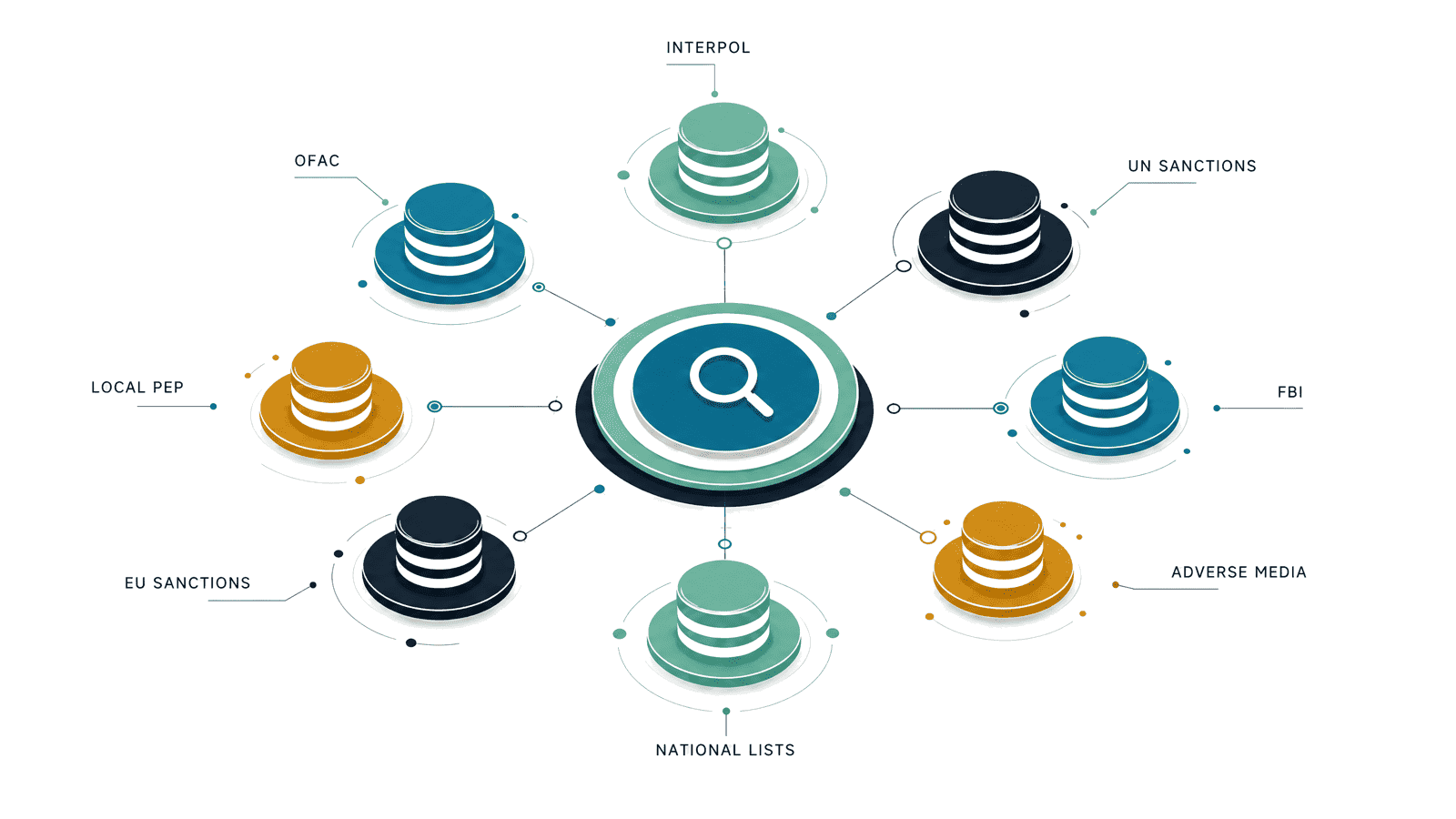
Sanctions, PEP and adverse media run through one matching and risk layer, not three separate lookups: sanctions lists (UN, EU, OFAC, HMT plus national and regional), politically exposed persons (global and domestic, relatives and close associates), and adverse media (negative news and enforcement action). Crime and law enforcement data and insolvency sit in the same layer, tuned per market, handling transliteration and the fact that a name is not an identifier. The two are different questions: a clean sanctions result does not answer whether the same subject carries a relevant conviction, an enforcement action or an active insolvency, which is why that check runs alongside sanctions rather than being sold as a separate product.
Current and historic status, direct and indirect. Indirect matters: the person who is not sanctioned but controls something that is.
A screen tells you about the day you screened. Monitoring tells you about the day it changed, which is the day that matters. Entities go under watch individually or as a portfolio, and the alert arrives when status moves.
Rather than reselling one source and calling the disagreements noise: where two sources disagree, that disagreement is itself a signal, and it is the one a single-source tool cannot see.
Coverage.
One matching layer across every risk category: sanctions and watchlist categories, financial crime, and the adverse-media risk indicators the engine classifies against. Coverage updates with the connected data sources.
A false positive is a cost to your operation.
A false positive is a cost to your operation. A false negative is a cost to your licence. Under monitoring, a false positive recurs on every check, for every entity you watch, while a false negative sits unnoticed until somebody finds it. That asymmetry is why most of our engineering goes into false positive reduction rather than into adding another list. Whitelists survive a data refresh. Cleared alerts stay cleared unless the underlying fact moves. A false negative is the quieter failure: no alert is raised and no record of the near-miss exists, so it surfaces later, when a regulator, a correspondent bank or a journalist finds it instead. Most misses are not exotic; they are the same person, written the way a different system, alphabet or culture writes them.
Built to be configured, not locked in.
Screening runs on its own, including behind somebody else's onboarding. Inside the platform it draws on the identity and company data already established, which is what makes the matching better. A confirmed sanctions match does not add points to a score: it overrides it outright and forces the highest risk tier regardless of every other factor, the same override logic the Poros risk engine runs on. Thresholds, fuzzy-match and name-variant tuning, alert prioritisation and approve, review or reject routing are all configurable to a bank's own risk appetite.
Two audiences.
Every false positive is a customer stalled for a mistake they did not make, not a risk the business ran.
The analyst view shows the match, why it matched, the evidence dossier, and one action.
Why us.
We run several sources and reconcile them, rather than reselling one and calling the disagreements noise.
Sourcing models and implementation detail live on the screening product page.